

The Ultimate Guide to Authenticating a Louis Vuitton Bag

Protect your investment with this step-by-step guide to the details that authenticators examine when evaluating Louis Vuitton handbags.
Estimated reading time: 12–15 minutes


Why Authenticating a Louis Vuitton Bag Matters
Louis Vuitton is considered one of the most frequently counterfeited luxury brands in the world. Modern replicas may include copied date codes, imitation receipts, convincing packaging, and hardware designed to resemble genuine components. Whether you are buying from a resale boutique, an online marketplace, or a private seller, careful authentication helps protect your investment.
The scale of the problem has led to major legal disputes. In 2008, a French court ordered eBay to pay LVMH, the luxury group that owns Louis Vuitton, €38.6 million in damages in a case involving counterfeit luxury goods and unauthorized sales. Counterfeiting remains a global problem today.
At Gypsy Cowgirl Boutique, every Louis Vuitton item we carry includes a Certificate of Authenticity (COA). This guide explains what buyers can examine, but it does not replace professional authentication.
Louis Vuitton Authentication Checklist
✓ Overall Feel: Structured, balanced, and high-quality.
✓ Stitching: Even, tight, and consistent.
✓ Canvas Pattern: Aligned appropriately for the model.
✓ Vachetta Leather: Shows natural aging rather than artificial coloring.
✓ Hardware: Feels solid, functions smoothly, and has crisp engraving.
✓ Heat Stamp: Clean, centered, and correctly spelled.
✓ Date Code: Aligns with the “Made In” label when present.
✓ Interior Materials: Materials and pocket layout match the model.
✓ Authenticity: Bag model, colorway, and construction actually existed.
✓ Verification: Authentication does not rely on packaging, receipts, or “auth cards” alone.
Quick Reference
Feature | Authentic Characteristics | Warning Signs |
Stitching | Even length, spacing, and stitch counts | Loose threads or mismatched tabs |
Canvas | Substantial texture and model-appropriate alignment | Plastic-like finish or distorted motifs |
Vachetta | Natural pale-to-honey aging | Painted orange or perfectly uniform patina |
Heat stamp | Crisp, centered embossing | Thick, crooked, blurry, or misspelled lettering |
Hardware | Solid feel and smooth operation | Rough edges, poor plating, or shallow engraving |
Date code | Format and location make sense for the era | Impossible week, year, or country combination |
1. Start With the Overall Quality
An authentic Louis Vuitton bag should feel carefully engineered rather than merely decorated. Its structure should be balanced, its materials substantial, and its details intentional.

2. Understand Louis Vuitton Date Codes
Before the early 1980s, Louis Vuitton did not use production codes. Pieces from this period must instead be evaluated by their interior labels, craftsmanship, materials, construction, hardware, and other brand-associated details.
Beginning in 1982, Louis Vuitton introduced production codes on many items to indicate when and, in later formats, where they were manufactured. The earliest codes used simple date-based formats, while later versions incorporated letters identifying the country or production location.

The next phase of Louis Vuitton production codes represents many of the pieces commonly seen on today’s resale market. These codes typically combined factory letters with numbers indicating the month and year of manufacture.

Beginning in 2007, Louis Vuitton changed the numeric portion of the code to identify the production week and year. The first and third digits represented the week, while the second and fourth digits represented the year. This visible format remained in use until Louis Vuitton began transitioning many products to embedded electronic identification in 2021.

The lining material and construction of the item often determined where and how the code was placed. Placement can vary, but the format should still be appropriate for the claimed production period.
Date codes may appear on a leather tab, inside a pocket, along an interior seam, or near the heat stamp. Since roughly early 2021, many newer Louis Vuitton items have used embedded electronic identification rather than a visible code.
Cross-Check the Date Code With the “Made In” Label
The factory letters should be consistent with the country-of-origin stamp and the production era. A mismatched country, impossible week number, or format that did not exist during the claimed year should raise questions.
Looking for a specific factory code? Jump to Appendix A – Louis Vuitton Factory Location Codes (Quick Reference).

Louis Vuitton Product Code Authenticator
The Louis Vuitton Product Code Authenticator is a helpful resource for decoding a visible production code and estimating its date and factory location.
Use it as a research tool rather than proof of authenticity. Counterfeiters can copy correctly formatted codes.
3. Examine the Stitching
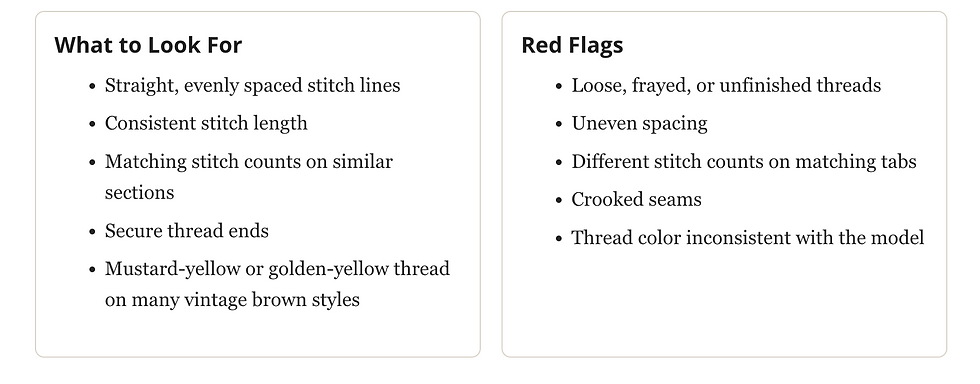
The stitching should be even, tight, and free of loose threads, with consistent stitch length and spacing. Similar sections across the bag should generally have the same number of stitches. For example, the stitch count on one handle tab should match the corresponding tab.

4. Inspect the Canvas and Pattern Alignment
Louis Vuitton coated canvas should feel durable, lightly textured, and substantial—not thin, slick, or overly plastic-like. Pattern alignment should be evaluated according to the construction of the exact model.

REAL | FAKE |
Softer brown tone | Darker, flatter background |
Smaller, balanced symbols | Oversized symbols |
Even pattern spacing | Wider, uneven spacing |
Refined canvas texture | Artificial-looking print |


Some authentic bags are made from one continuous piece of canvas. On certain Speedy models, the Monogram may appear upright on one side and upside down on the other. That is a construction feature, not an automatic flaw.
5. Evaluate the Vachetta Leather
Vachetta is a natural, vegetable-tanned cowhide closely associated with Louis Vuitton’s travel heritage. The brand has long used it for handles, piping, trim, luggage tags, and other details on many Monogram and Damier Azur pieces.

Because traditional vachetta is minimally treated and lacks a heavy protective coating, its natural grain, veins, and markings may remain visible. When new, it is pale cream or light beige. Exposure to air, sunlight, moisture, and oils from handling gradually develops a honey, amber, or caramel-colored patina unique to the item.

Water spots, scratches, and uneven patina do not automatically indicate a counterfeit. They may simply reflect the bag’s age, use, and history.
6. Inspect the Hardware
Authentic Louis Vuitton hardware should feel substantial, attach securely, and operate smoothly. Depending on the model and production period, components may be branded Louis Vuitton or associated with manufacturers such as Éclair or Lampo.


7. Review the Heat Stamp
A typical interior stamp may read “LOUIS VUITTON,” “Paris,” and a country of manufacture such as France, the USA, Spain, Italy, or Germany. The lettering should look precise, balanced, and professionally embossed.

Pay close attention to the rounded “O”s and the compact “TT” lettering in VUITTON, while keeping in mind that fonts can vary by era and product type.
8. Examine the Interior
Authentic Louis Vuitton bags use high-quality interior materials that feel substantial rather than thin or overly synthetic. Depending on the model, Louis Vuitton has used cotton or textile fabric, Alcantara microfiber, microfiber suede, canvas, and leather.
The lining color is specific to the model. Many Damier Ebene bags, for example, are known for scarlet-red textile interiors. A different lining color, cheap fabric, or an incorrect pocket layout may be a warning sign.

9. Verify the Model and Compare With Authentic Examples
One of the most effective questions to ask is: Did Louis Vuitton actually make this bag?
Research the exact model’s colorway, material, hardware finish, measurements, interior layout, pocket placement, handle or strap design, collection year, and country of manufacture.
Counterfeit manufacturers sometimes create combinations Louis Vuitton never produced, such as an incorrect lining color, mismatched hardware, unauthorized material, or a nonexistent variation.
Once the model is identified, compare it with verified authentic examples of that exact style. Construction details can vary widely across collections, production years, and manufacturing locations.
10. Do Not Trust Authentication Cards Alone
Louis Vuitton does not traditionally issue handbag authenticity cards, unlike some other luxury brands.
Authentic items may include dust bags, care booklets, receipts, boxes, gift packaging, and retail tags. However, these accessories can be copied or paired with counterfeit merchandise.

11. Consider Professional Authentication
When purchasing a valuable Louis Vuitton item, professional authentication can provide important peace of mind.
Experienced authenticators examine materials, construction, hardware, fonts, stitching, heat stamps, production codes or embedded identification, interior configuration, manufacturing characteristics, and model history.
A professional Certificate of Authenticity may also increase buyer confidence and provide useful documentation for future resale.
Frequently Asked Questions
Can a Louis Vuitton bag be authentic without a date code?
Yes. Some older bags may have no visible code; a code may be worn or difficult to locate, and many newer pieces use embedded identification instead.
Does a date code prove authenticity?
No. A production code is only one supporting detail and can be copied.
Does Louis Vuitton provide authenticity cards?
Louis Vuitton does not traditionally issue handbag authenticity cards like those used by some other luxury brands.
Can Louis Vuitton authenticate a pre-owned bag?
Louis Vuitton does not generally provide independent Certificates of Authenticity for pre-owned items. A reputable third-party authentication service is often the most practical option.
Can an authentic Louis Vuitton bag be made outside France?
Yes. Authentic Louis Vuitton items have been produced in several countries, including France, Spain, Italy, Germany, Switzerland, and the United States, depending on the model and production period.
Shop With Confidence at Gypsy Cowgirl Boutique
Buying pre-owned luxury pieces should be exciting—not stressful.
At Gypsy Cowgirl Boutique, every Louis Vuitton handbag, wallet, and accessory we offer is carefully inspected and includes a Certificate of Authenticity before being listed for sale.
Whether you are shopping for your first Louis Vuitton piece or adding a vintage find to your collection, you can shop with confidence knowing authenticity is a priority.
Appendix A – Louis Vuitton Factory Location Codes (Quick Reference)
Factory codes can be useful supporting information, but some codes have been associated with more than one country or production period. Use the code together with the date format, country-of-origin stamp, model, and era.

Final Thoughts
Authenticating a Louis Vuitton bag is not about finding one perfect clue. It is about examining the entire piece—from the canvas, stitching, vachetta leather, and hardware to the heat stamp, date code, interior, and overall construction.
The more authentic Louis Vuitton pieces you study, the easier it becomes to recognize the brand’s craftsmanship and spot details that do not belong. When purchasing a high-value item, professional authentication remains the best way to gain confidence and protect your investment.
Because the best luxury finds come with a little history, a lot of style, and the confidence of knowing you found the real thing. Happy hunting—and may your next Louis Vuitton treasure be the one you have been waiting for!

This guide is intended for educational purposes and does not replace professional authentication. Louis Vuitton® is a registered trademark of its respective owner. Gypsy Cowgirl Boutique is not affiliated with, endorsed by, or sponsored by Louis Vuitton.


Comments